Property Taxes
Frequently Asked Questions
With potential upcoming changes to Florida’s property tax system, the Town of Redington Shores wants to ensure that residents understand how property taxes work, where their money goes, and why these local revenues are essential to maintaining the high quality of life the community enjoys. Find some common questions below.
 General Questions
Q: How are property taxes determined?
A: Property taxes are calculated by multiplying your property’s taxable value by the millage rate, then dividing by 1,000. The basic formula is: (Taxable Value / 1,000) × Millage Rate = Annual Property Tax.
Q: Who sets my property value?
A: The Pinellas County Property Appraiser determines your property’s assessed value each year. This is different from market value and may be limited by Save Our Homes caps.
Q: What portion of my property taxes goes to the Town of Redington Shores?
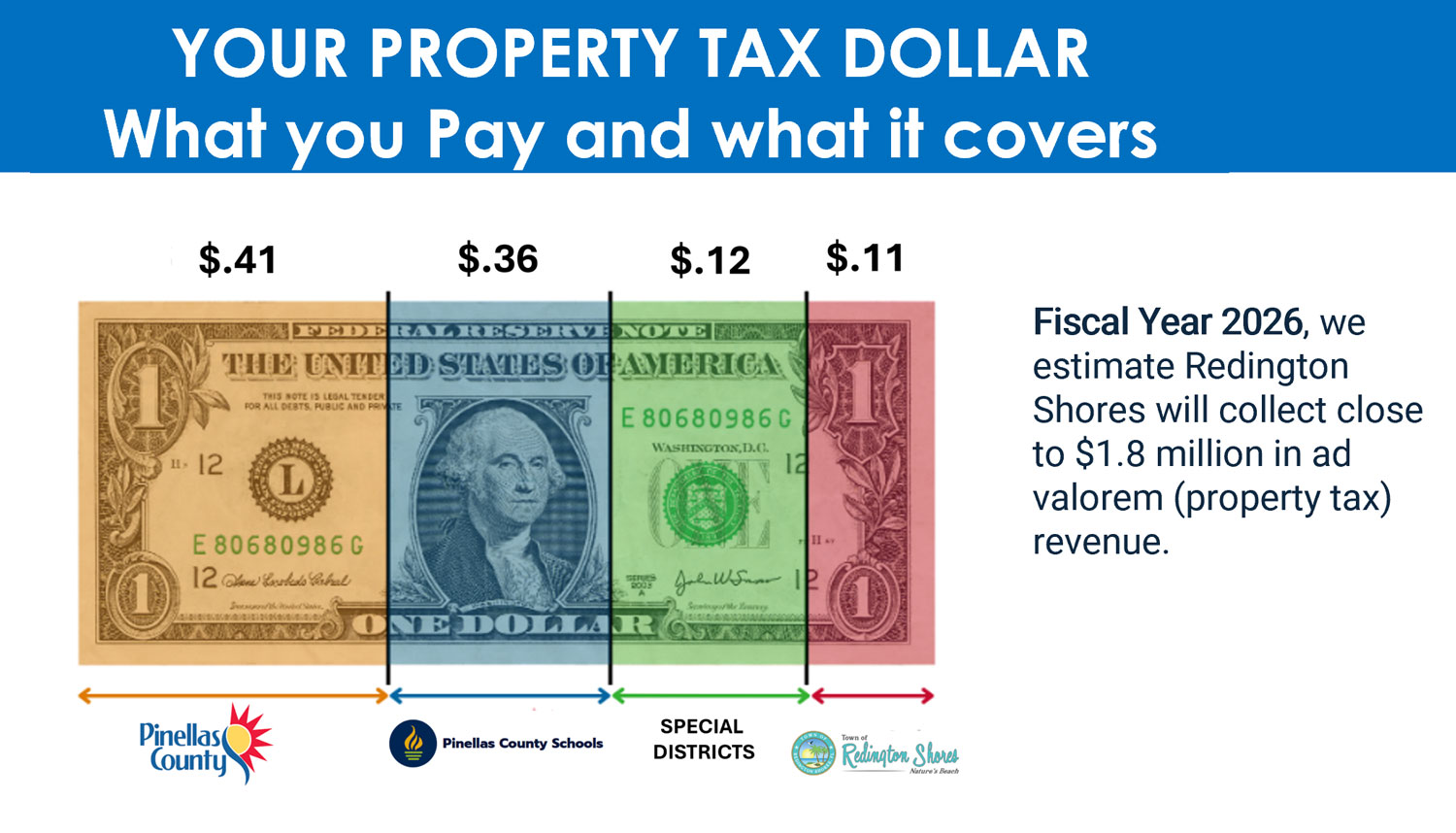
A: When your annual property tax is sent off to the Pinellas County Tax Collector, that money is divided among several government agencies. Only about 11% of your total property tax bill goes to the Town of Redington Shores. The majority goes to Pinellas County government (41%) and Pinellas County Schools (36%). Special districts receive 12%.
Q: What is a millage rate?
A: The millage rate is the tax rate per $1,000 of assessed value. The town’s 2026 millage rate is 1.6896 and represents about $.11 cents out of every property tax dollar paid – as shown in the illustration above.
Q: Can the Town of Redington Shores control my entire property tax bill?
A: No. The Town can only control its portion (11% of your bill). We cannot influence rates set by the school district, county, or special districts.
Q: What happens if property taxes are eliminated?
A: Eliminating local property taxes won’t eliminate costs, it just shifts them. Think higher sales taxes, new fees, or cuts to those essential Town services. It will also reroute decision-making from local communities to Tallahassee.
Q: Isn’t Florida already a low-tax state?
A: Yes. Florida ranks among the most tax-efficient states in the nation. Our property tax burden is about half that of Texas, thanks to smart spending, local accountability, and the “Florida Formula” that keeps dollars and decisions close to home.
Save Our Homes and Exemptions
Q: What is Save Our Homes?
A: Save Our Homes is a Florida constitutional amendment that caps annual increases in assessed value at 3% for homesteaded properties, protecting longtime residents from dramatic tax increases.
Q: How do I qualify for homestead exemption?
A: You must make the property your permanent residence as of January 1 and apply with the Pinellas County Property Appraiser by March 1.
Q: Why are my taxes different from the previous owner?
A: When property changes ownership, exemptions are removed and the property is reassessed at current market value. You must reapply for exemptions.
City Services and Budget
Q: What do Town property taxes fund?
A: For Fiscal Year 2026, we estimate Redington Shores will collect close to $1.8 million in ad valorem (property tax) revenue, which is invested in essential services, including: Law Enforcement ($649,000), Fire and Emergency Services ($293,000), Parks ($155,000), Roads & Streets ($216,500), Library Services ($55,150).
Q: How much does the Town spend on public safety?
A: In 2026, Redington Shores spent $649,000 on law enforcement services and $293,000 on fire/EMS services.
Q: Has Redington Shores raised property tax rates recently?
A: No. Your property tax rate is determined by the millage rate. The town’s current millage rate of 1.6896 mills is the 3rd lowest rate among all Pinellas County cities and towns. We have kept that low millage rate for many years despite rising costs. There is no plan to raise that rate. Commissioners and staff work hard to manage costs and spend responsibly.
Getting Help
Q: How can I appeal my property assessment?
A: Contact the Pinellas County Property Appraiser‘s office. They have formal appeal processes and can explain how your assessment was determined.
Q: Where can I get more information about exemptions?
A: Visit the Pinellas County Property Appraiser website or call their office directly for information about available exemptions and application procedures.
Q: How can I stay informed about City budget decisions?
A: Attend Town meetings, participate in budget hearings, read budget documents on the Town website, and sign up for RShores app.